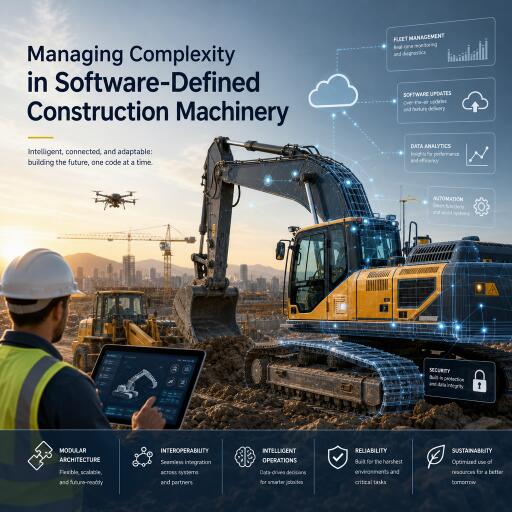
Managing Complexity in Software-Defined Construction Machinery – Archynewsy
Excavators, loaders, and graders are no longer defined solely by steel and hydraulics—software now sets the pace for capability, safety, and uptime. As heavy machinery evolves into rolling computers with booms and buckets, the core challenge is taming complexity: real-time decision-making, fusing torrents of sensor data, and orchestrating automation across heterogeneous subsystems without ever compromising safety. The result is a shift toward purpose-built software architectures that make construction equipment updatable, testable, and future-ready.
From Isolated ECUs to Centralized Intelligence
For decades, machines were stitched together from standalone electronic control units linked over CAN. That model is giving way to centralized domain controllers and high-performance vehicle computers. This consolidation unlocks several advantages:
- Over-the-air updates for rapid feature rollouts and bug fixes.
- Tighter integration of assistive and autonomous capabilities—think collision avoidance, dig depth control, and smart grading.
- Reduced wiring complexity and improved system observability across the entire machine.
To keep pace with this architectural pivot, builders are adopting service-oriented principles. Functions are decoupled from specific hardware so software components can be simulated, validated, and deployed more flexibly. Virtual commissioning—running control logic against high-fidelity digital twins—allows teams to vet behaviors before a single trench is cut.
Real-Time Performance Without Compromise
Construction sites are unforgiving. A millisecond delay can be the difference between a smooth swing and a costly collision. That’s why deterministic operating systems and real-time scheduling are foundational elements of modern machinery software. Safety-critical tasks—emergency braking, overload prevention, stability control—must preempt everything else, every time.
Achieving that reliability means handling high-bandwidth sensor streams (LiDAR, radar, stereo cameras, ultrasonic arrays) with predictable latency. Sensor fusion pipelines prioritize time synchronization, redundancy, and graceful degradation so the machine remains safe even when data gets noisy or a component fails.
Key Building Blocks of Software-Defined Machines
- Centralized and zonal compute: Heavy workloads move from edge actuators to powerful controllers, trimming harness weight and simplifying maintenance while improving coordination across subsystems.
- Virtualization and partitioning: Multiple domains can share the same hardware. Safety-certified control software runs in isolated partitions, separate from non-critical apps like telematics or operator UX.
- Standardized middleware: Publish–subscribe messaging and DDS-style frameworks enable portable, testable services that scale across machine families and suppliers.
- Model-based development: Control strategies are authored, simulated, and auto-generated into code, tightening the loop from design to deployment.
- Time-sensitive networking: Deterministic Ethernet ensures that time-critical traffic gets through, even in chatty networks.
Security and Lifecycle at Fleet Scale
Software-defined machines don’t just ship—they live. Secure boot chains, encrypted comms, and signed updates safeguard equipment from tampering. Once deployed, continuous integration and delivery pipelines push improvements across fleets, supported by telemetry that highlights performance drift, component wear, and operator usage patterns.
Containers and microservices let teams evolve functionality incrementally, while canary rollouts limit risk. Meanwhile, digital twins mirror each machine’s configuration, enabling predictive maintenance and scenario testing—from new bucket control strategies to path-planning tweaks—without bringing job sites to a halt.
Automation That Fits the Job Site
Autonomy in construction rarely means full driverless operation across an entire site. Instead, it’s about targeted capabilities that de-risk repetitive or hazardous tasks: semi-automated trenching, obstacle-aware hauling, assisted grading, or remote operation in unstable terrain. These features depend on robust perception stacks, reliable communications, and human-machine interfaces that blend operator intuition with machine precision.
Lessons from real-time simulation and game engines are increasingly relevant here. Tight feedback loops, predictive control, and intuitive visualization give operators a deeper sense of machine intent, improving trust and productivity while keeping safety front and center.
The People and Process Challenge
The biggest hurdles aren’t purely technical. Organizations built around mechanical engineering and embedded firmware are retooling for DevOps-era velocity. That means:
- Upskilling teams in safety-certified software development and cybersecurity.
- Standardizing interfaces so suppliers can plug into shared platforms without bespoke integration for every model.
- Adopting agile practices that still satisfy rigorous validation and compliance requirements.
As codebases swell into the millions of lines and platforms span entire product lines, governance becomes crucial. Clear ownership, robust testing pipelines, and traceability from requirements to runtime behavior are what separate elegant architectures from unmanageable ones.
What’s Next
In the near term, expect more convergence: unified compute platforms, shared software stacks across machine classes, and greater use of AI for perception and operator assistance. Remote operation will expand, supported by low-latency links and fail-operational design. Over time, standardized software foundations will become table stakes, enabling OEMs to differentiate with faster iteration cycles, deeper integration with site planning tools, and smarter, safer machine behaviors.
The endgame isn’t simply putting more code into iron. It’s about building adaptive systems that learn from the field, update seamlessly, and empower crews to do more with less risk—turning heavy equipment into agile, continuously improving tools for the world’s toughest work.